
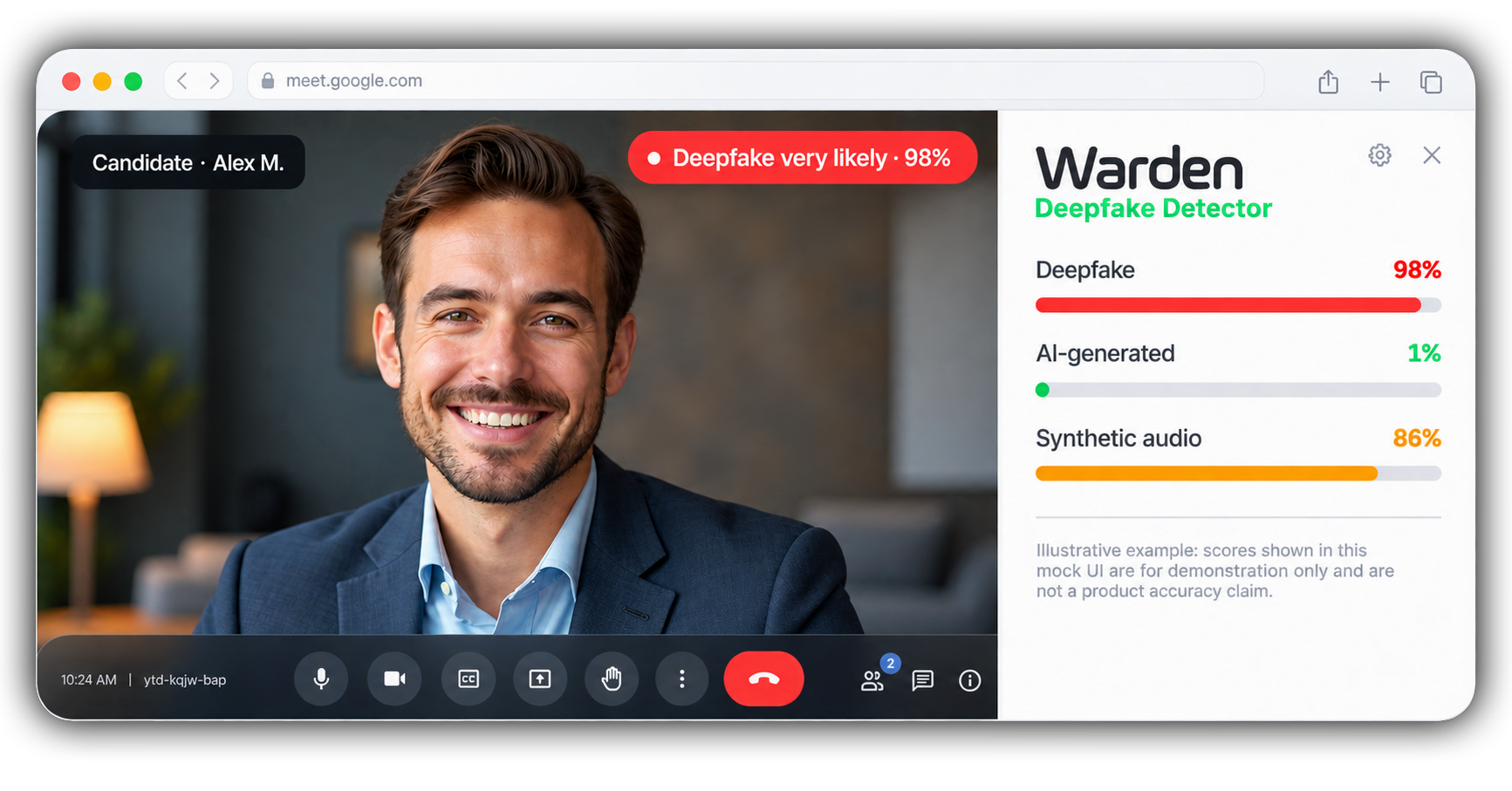
Live deepfake detection - know who is really on the call.
Deepfake candidates and proxy interviewers are slipping past remote hiring pipelines - Wardento flags synthetic video and voice the moment it appears on the call.
Pre-launch · Limited to early registrants
Lock in 50% off - any plan,
first 2 months.
Get 50% off your first 2 months on any Wardento subscription plan. No payment now, no obligation - just your email to hold your spot before we launch.
The problem
Remote hiring wasn't built to catch a synthetic face
Deepfake candidates are already in your pipeline
Public reporting has flagged a sharp rise in deepfake candidate detection cases - job seekers using real-time face-swap tools and AI-generated audio to impersonate someone else during video interviews. Pindrop's 2025 Voice Intelligence & Security Report[1] found deepfake fraud attempts surged more than 1,300% in a single year, and separate research tracking 19,368 live interviews[2] found AI-cheating behavior flagged in 38.5% of them. Experian's 2026 Future of Fraud Forecast[3] now lists deepfake job candidates among the top five fraud threats of the year.
Traditional interviews can't verify identity anymore
Recruiters trained on soft signals - eye contact, cadence, body language - are being reliably fooled by consumer-grade generators. Standard video interview verification was designed for the good-faith web, not for adversarial AI interview fraud, where the "candidate" on screen may be a proxy or a fully synthetic identity. A peer-reviewed meta-analysis pooling 56 studies[4] found humans detect deepfakes with only 55.5% accuracy - statistically no better than a coin flip.
A fraudulent hire is a full-spectrum business risk
Once an impersonator is inside, the fallout compounds - credential misuse, data exfiltration, sanctions exposure, and audit findings that force a painful rehire. This isn't hypothetical: in one documented U.S. Department of Justice case[5], a North Korean IT-worker scheme using stolen identities and deepfake-assisted hiring left affected companies with at least $3 million in losses from legal fees and network remediation[6] - including the exposure of export-controlled defense data at one U.S. contractor. Google Meet security is the last practical checkpoint before payroll - and until now, it's had no visibility into synthetic media at all.
How Wardento works
Three steps from install to verdict
Unlike generic deepfake detectors that require uploading recordings after the fact, Wardento runs where the interview actually happens - inside Google Meet, with zero workflow disruption.
Install the Google Meet plugin
Add Wardento from the Google Workspace Marketplace in one click. Verified by Google's review process. No separate app to open, no change to how interviewers already run their day.
Invite our bot to your call
We keep a queue of Google Meet bots on standby. Invite one into any call and it joins within seconds, waiting quietly until you're ready to start a check.
Start detection in a few clicks
Kick off a scan on demand and get a verdict with supporting proof in live detection session, or come back to review it later. Checks run through certified third-party deepfake-detection processors.
Proof, not just a verdict
Every scan comes back with the evidence behind it
Results land almost immediately with a confidence score and the specific signals that drove the call - reviewable right away or saved to come back to later.
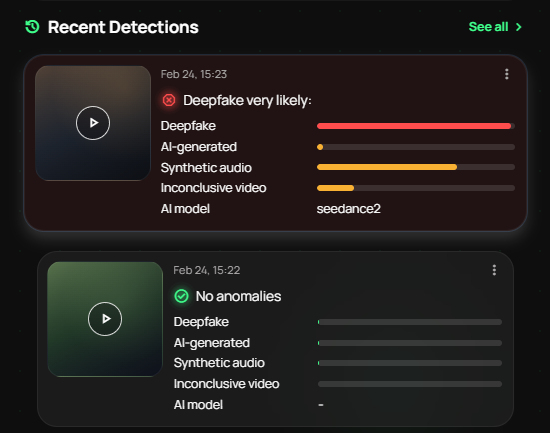
Real-time, not post-mortem
Detection happens live during the interview - reviewers act in the moment, not days later.
Purpose-built Meet bots
A queue of dedicated bots join on request and run checks live - no separate recording pipeline to configure.
Private by design
Certified third-party detection vendors, configurable data retention, and no training on your candidate footage.
Used Only For Detection Proof Recaps
Any stored session data is used only inside the UI to show recap details in detection proofs. It is not repurposed for advertising, resale, or unrelated analytics.
You Decide Retention, Including Zero Storage
By default, we destroy all session data after 14 days. After that, it is permanently deleted. You can also disable storage entirely; if you do, recap history in detection proofs will not be available.
Certified Third-Party Deepfake-Detection Processors
Detection checks run through certified third-party deepfake-detection processors, with results returned to your workspace for review.
Data protection first
Your data stays yours
We care about your data. Only you control it. We do not sell your data to anyone, and we follow GDPR standards in how data is handled.
Open mic
Got a thought? Tell us anything.
A missing feature. A concern about how detection should work. A blunt take on the whole idea. No idea too small, no complaint too blunt.